How far would you go to help the people you love?
Edie Meeks, an Army Nurse Corps veteran, traveled halfway around the world, trading Midwest cornfields for the Central Highlands of South Vietnam.
In 1968, Meeks’ brother Tom had been drafted and joined the Marine Corps. Meeks felt compelled to serve, too. She wanted Tom, and every soldier like him, to be cared for by someone who had chosen to be there. Her decision to join the Army Nurse Corps set the course for decades of service after the war ended.
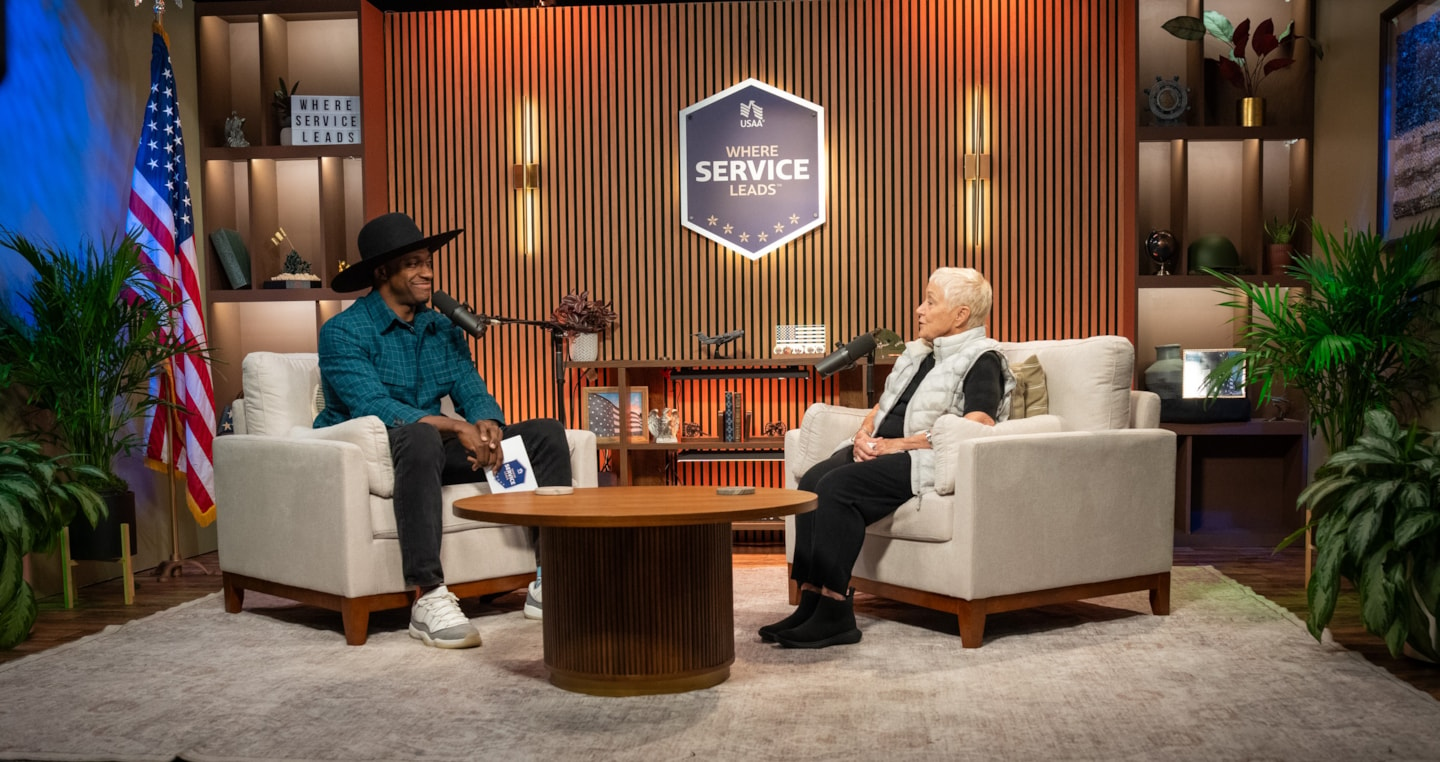
In Where Service Leads, a podcast from USAA, stories like Meeks’ show how military service transforms a life, both in the moment and throughout life’s journey. Meeks’ vivid memories also shed light on a part of the Vietnam War that went untold for far too long: the women who served in it.
The Nurses’ War: Approximately 10,000 military women served in Vietnam. Like Meeks, many volunteered to serve as nurses, at an average age of 23 years old.

The Vietnam War was one of the first conflicts where a helicopter could carry a wounded soldier from the battlefield to a hospital in as little as 30 minutes, and those who reached one within an hour had a survival rate of 98 percent1. That speed saved thousands of lives. It also meant young nurses like Meeks faced injuries few civilian nurses would ever see, day after day.
Despite their proximity to battle, in 1968, nurses weren’t thought of as soldiers. “The nurses were nurses who took care of the soldiers,” Meeks remembers. Their stories rarely made it home to a country already deeply divided over the war, a divide Meeks felt inside her own family. While Tom served, her brother Charlie protested.
“I knew that he hated the war, but he loved me,” she says.
The year Meeks served in Vietnam changed her life forever. “When you’re young, you think you can handle just about anything,” Meeks says.
Before the Army, Meeks worked at a 46-bed hospital where, if the doctor couldn’t make it in, the nurses stepped up for everything from child delivery and trauma care. But as an intensive care nurse at the 71st Evacuation Hospital in Pleiku, she found that nothing had prepared her for the state of her patients. In a stateside emergency room, she says, “everything makes sense.” In Vietnam, nothing did. No patient was ever just a number. “Every one of them was my brother,” she says.
The Wounds That Came Home
Meeks came home believing she was the same person who had left. She wasn’t. For nearly 20 years, she set Vietnam aside, until an unexpected moment led her into a VA clinic to ask for help.
Meeks and a young psychologist worked together to understand what PTSD looked like in women, who, she believes, often process trauma differently than men. Today, the VA offers clinics and specialized care for women, a change driven by the growing number of women in uniform, including in combat, and by women veterans who insisted on it.
Her advice for anyone still struggling: “It’s everyone in their own time. There is no recipe for recovery.”

Service Brings You Back
What finally helped Meeks process was more service. Diane Carlson Evans, a lifelong best friend who had shared Meeks’ hooch in Pleiku, spent years leading the campaign for a memorial honoring the women who served in Vietnam and urged Meeks to speak about her experience. An invitation to speak to Meeks’ daughter’s class about Vietnam veterans was finally what helped Meeks to revisit her Vietnam memories.
When the Vietnam Women’s Memorial was dedicated on Veterans Day 1993, Meeks felt as if she had arrived on “an island where everybody spoke the same language.” On the drive home, she cried for four hours.
Eventually, she joined the memorial’s board and now serves on the board of the National Purple Heart Honor Mission. When asked what that work means to her today, she doesn’t hesitate. “It’s my sanity,” she says.
“If you start giving service to your fellow soldiers, you’ll start getting better.”
This past Veterans Day, Meeks spoke at the Vietnam Veterans Memorial in Washington, D.C., about her own service and in memory of the late Carlson Evans. For Meeks, it’s all part of the journey. From the keepsakes she still has from her time in Pleiku to the Veterans Day reunions she never saw coming, Meeks says that despite everything that happened, she would do it all again “in a heartbeat”.
Where Service Leads is available on Apple Podcasts, Spotify and YouTube.